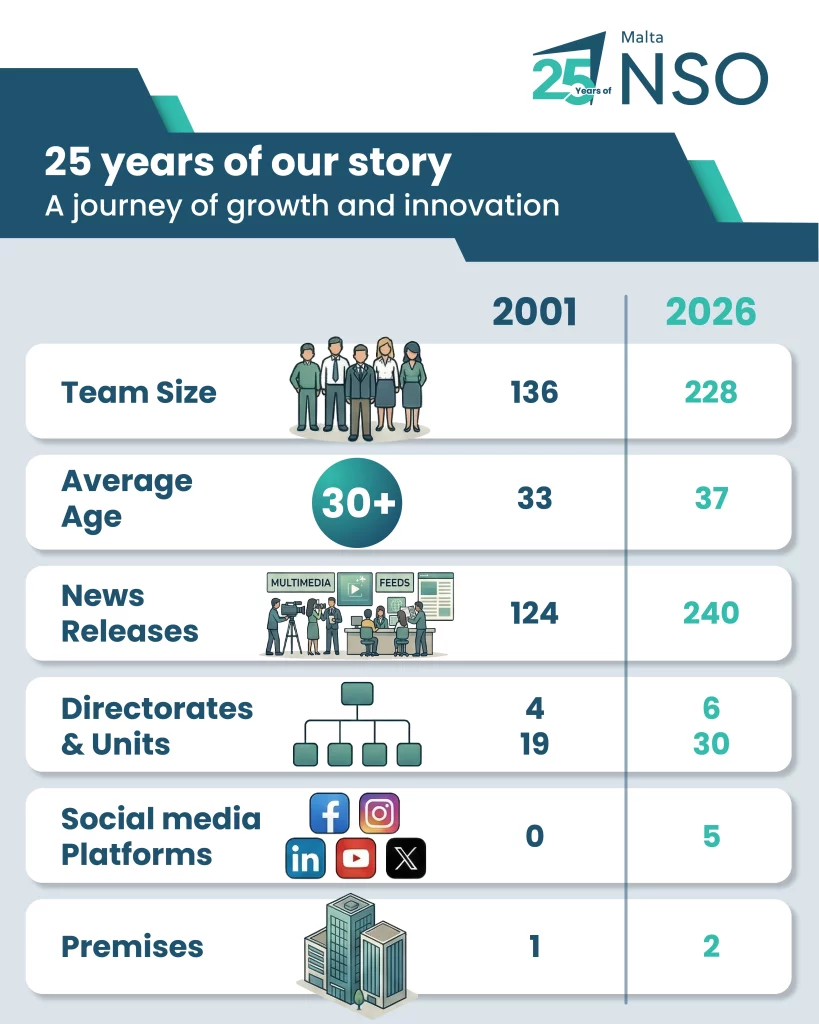
Over the past 25 years, the National Statistics Office (NSO) has charted a remarkable journey — evolving from a traditional statistical institution into a modern, agile, and trusted organization at the heart of Malta’s evidence-based decision-making landscape. This journey began on 1 March 2001, when the Central Office of Statistics (COS) was officially transformed into the NSO under the Malta Statistics Authority (MSA) Act. This Act granted the Office regulatory and executive independence, establishing a clear legal mandate and set the foundations for the modern, professional and trusted national statistical system we know today.

Years 2000 - 2005
In its formative years, the NSO strengthened its operational capacity with the signing of the first collective agreement for employees in 2002. These first years also saw the launch of two key social surveys – the Household Budgetary Survey (HBS) in 2001, followed by the EU Survey on Income and Living Conditions (SILC) in 2005. During the same period, the Labour Force Survey (LFS), first introduced in 2000, reached an important milestone when in 2004 it became a continuous survey. These three surveys are now established products of the NSO’s statistical programme, contributing to harmonised European social indicators while offering essential insights for national policy makers, researchers and the public. In 2003, an important milestone was also set within economic statistics when the Office published the first Gross Domestic Product (GDP) and Gross National Product (GNP) consistent with the European System of Accounts (ESA). The first telephone survey, WinCati, conducted in the same year and the launch of a new website and online database, StatDb 1.0, in 2005, also set the foundation for future digital transformation and modernisation of data collection and dissemination.
Years 2006 - 2010
Building on these early foundations, the mid and late 2000s marked a phase of quality enhancement and growing international engagement. In 2005, the NSO formally adopted the European Statistics Code of Practice, aligning itself with European standards of quality and integrity in statistical production. This paved the way for the first EU-harmonised Census of Population and Housing in 2011. The Office further expanded its outreach in 2008 with the release of its first anonymised survey dataset for research use, strengthening collaboration with the academic and research community. A year later, in 2009, the NSO adopted the International Monetary Funds’ (IMF) Special Data Dissemination Standard (SDDS) and hosted the Directors General of National Statistical Institutes (DGINS) conference. During this period the Office was also recognised with the Equality Mark, reflecting its commitment to gender equality in employment.
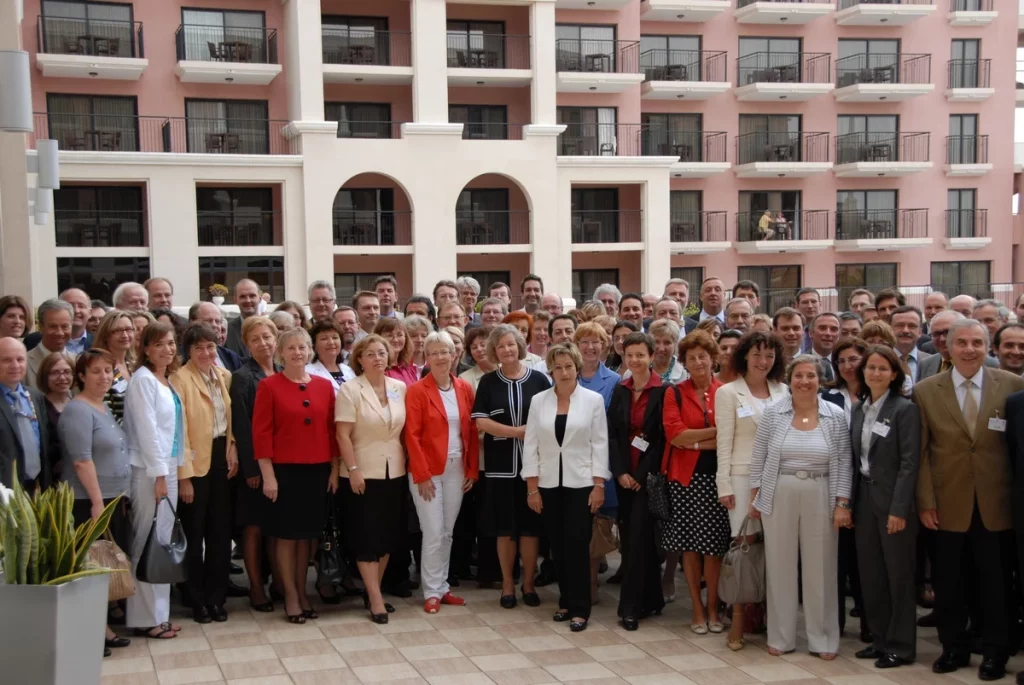
The NSO hosts the Directors General of National Statistical Institutes
(DGINS) conference (2009)
(DGINS) conference (2009)
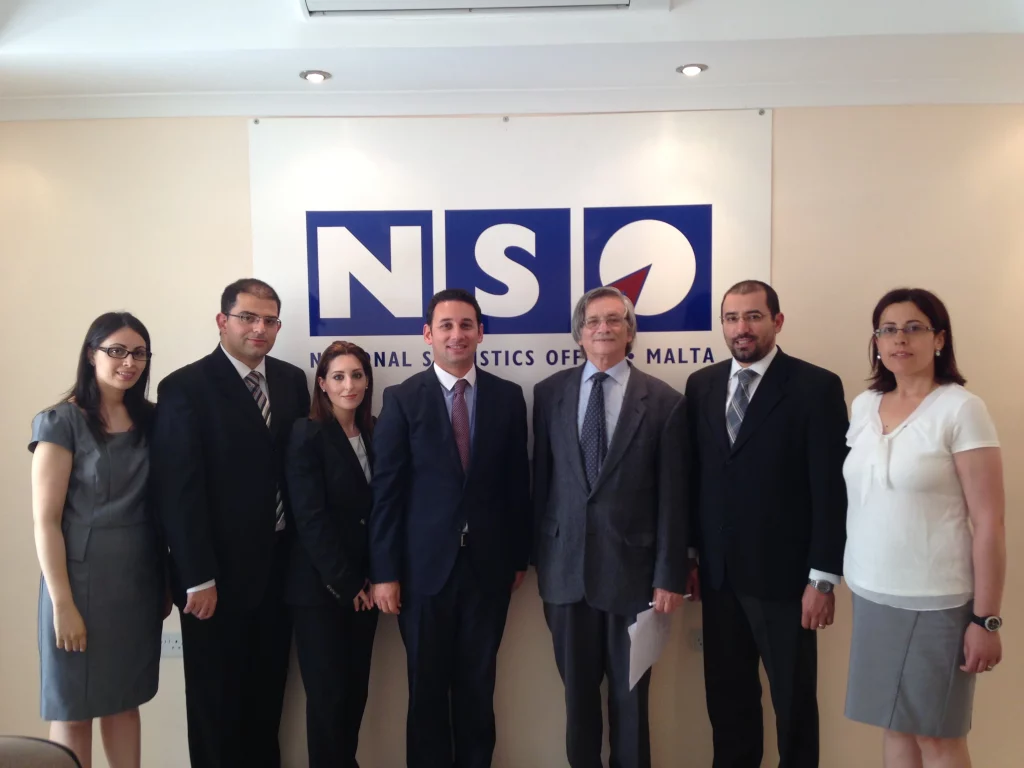
Opening of NSO’s regional office in Gozo (2014)
Years 2011 - 2014
The following decade was characterised by further modernisation and user engagement. In 2011 a new unit was set up to focus on improving the quality of the Business Register which serves to provide an up-to-date and exhaustive list of all enterprises and individuals conducting business in Malta. In 2013, the NSO established its presence on social media, opening new channels of communication with the public. This was followed in 2014 by the opening of a regional office in Gozo and the launch of a revamped website, alongside a dedicated platform for metadata. The first user satisfaction survey, conducted in the same year, further underscored the Office’s growing focus on user needs.
Years 2015 - 2020
Institutional capacity continued to expand through the establishment of a dedicated directorate for Data Resources, IT and Methodology in 2015, the centralisation of data collection with the creation of the Data Collection Unit in 2016, and the establishment of a Directorate for Finance and Premises Management in 2022. Digital transformation and innovation continued to evolve with the introduction of a dedicated Geographic Information System (GIS) function in 2016, strengthening the Office’s capabilities in spatial analysis. In 2018, the Office compiled and submitted the first environmental economic accounts in line with the relevant European regulation and in the same year, reached an important milestone in data collection methods, with the introduction of tablet-based surveys. This marked the beginning of a gradual transition away from paper-based operations.
Quality, information security and resilience became defining pillars. The revised European Statistics Code of Practice was adopted in 2017, a year that also saw the NSO play a key role during Malta’s presidency of the Council of the European Union. In 2018, the Prime Minister’s signing of the national Commitment on Confidence in Statistics confirmed the trust and professional independence held by the Office. In 2019, the Office reached an important milestone in information security when it achieved ISO/IEC 27001 certification for its information security management system. A true test of adaptability and resilience emerged during the COVID-19 pandemic in 2020. Almost overnight, the Office shifted to remote operations, ensuring uninterrupted statistical production while safeguarding staff wellbeing. Despite the unprecedented challenges, the Office undertook new projects including the coordination of Malta’s Sustainable Development Indicators (SDIs) in support of monitoring the UN Sustainable Development Goals (SDGs).

Years 2021 - 2023
The 2021 Census of Population and Housing marked another milestone in modernisation with the introduction of web-based data collection. This year was characterised by further initiatives reflecting the Office’s strong focus on strategic planning, commitment to process standardisation, and modernisation of the national statistical system. This was exemplified by the publication of the first multi-annual work programme, the launch of the multi-year Statistical Production Service Architecture (SPSA) transformation project, the adoption of the Generic Statistical Business Process Model (GSBPM), the first Global Value Chains (GVCs) census, and the publication of Malta’s first SDG monitoring report. In 2023, a new corporate identity and website were launched, symbolising the beginning of yet another chapter in the Office’s evolution.

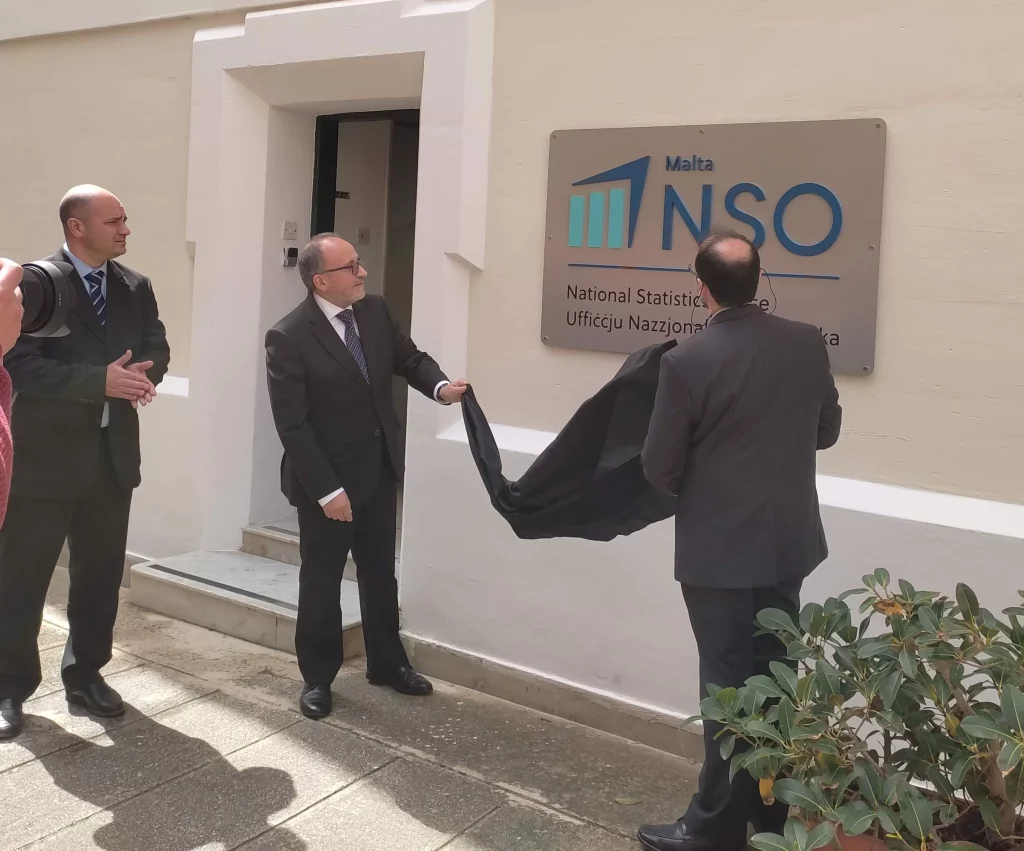

Old NSO Logo
Launch of the NSO’s new corporate identity (2023)
New NSO Logo
Years 2024 - 2025
The national statistical system continued to expand in 2024 with the designation of two Other National Authorities (ONAs). Responding to growing demands of a modern statistical system, the NSO introduced innovative products, enhanced capacity building, and sustained its emphasis on quality. In 2025, this included the launch of interactive online SDG and statistics portals, the introduction of smart data sources with the analysis of card payment transactions, the relocation of the Gozo office to larger premises and the release of the Office’s inaugural Quality Management Framework.
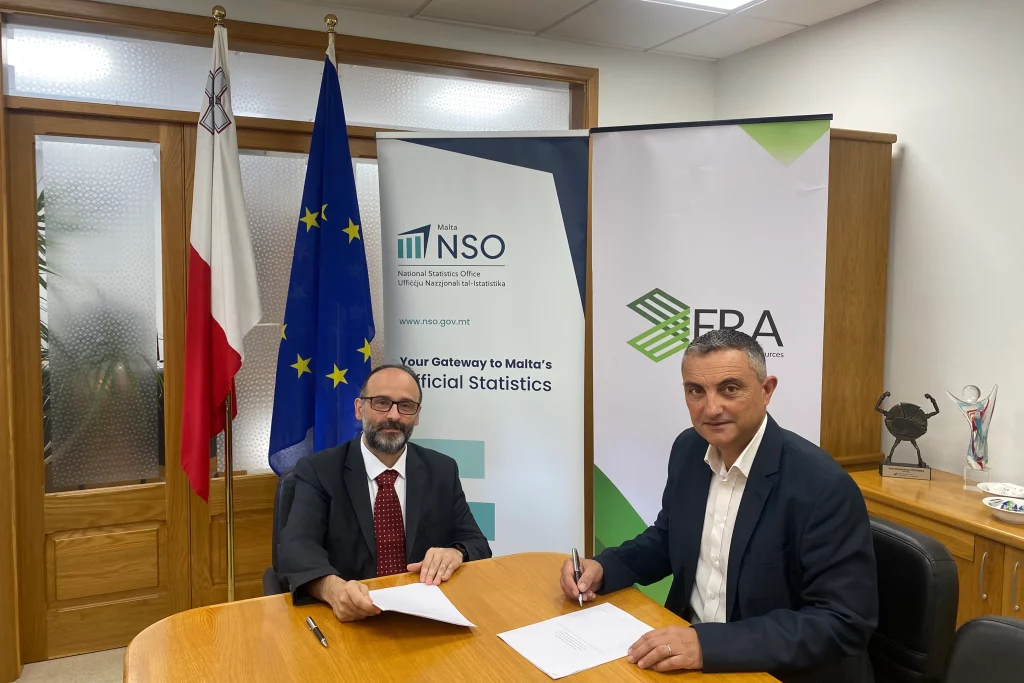
The NSO signs a memorandum of understanding with the Environment and Resources Authority, officially designating it as an Other National Authority (ONA) within the national statistical system (2024)
This recent period also served to reinforce the NSO’s strong national and international standing. In 2025, the Office received the Public Service “Good Governance Award” and hosted the national conference “Data for Today and Tomorrow”. The NSO’s significant role within the wider European statistical community also expanded. In 2024, the Office launched the inaugural “Data Smackdown Competition” as part of the European Statistics Competition and hosted an official visit by Eurostat’s Director-General. In the same year, the NSO’s Director-General was elected to the Partnership Group of the European Statistical System.
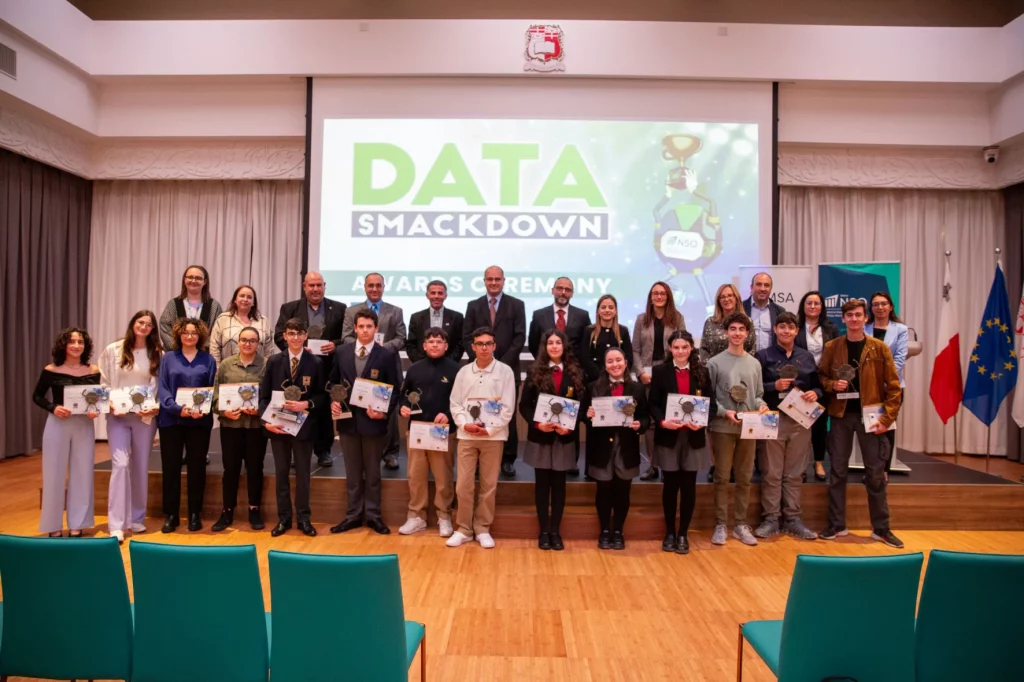
Launch of the first “Data Smackdown Competition” as part of the
European Statistics Competition (2024)
European Statistics Competition (2024)
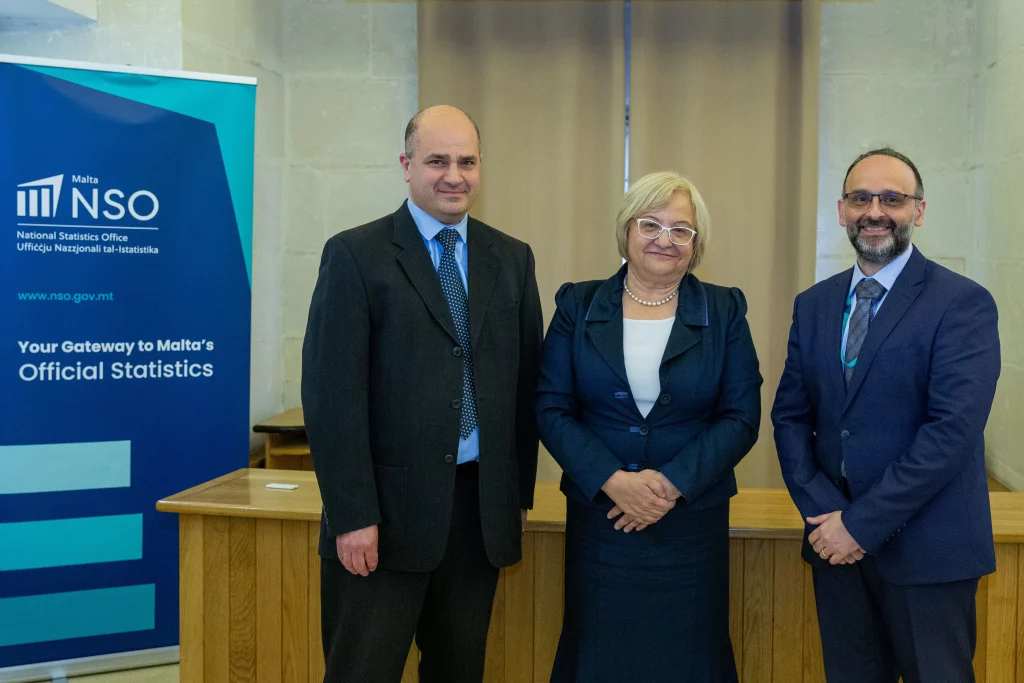
The NSO hosts an official visit by Eurostat’s Director-General (2024)

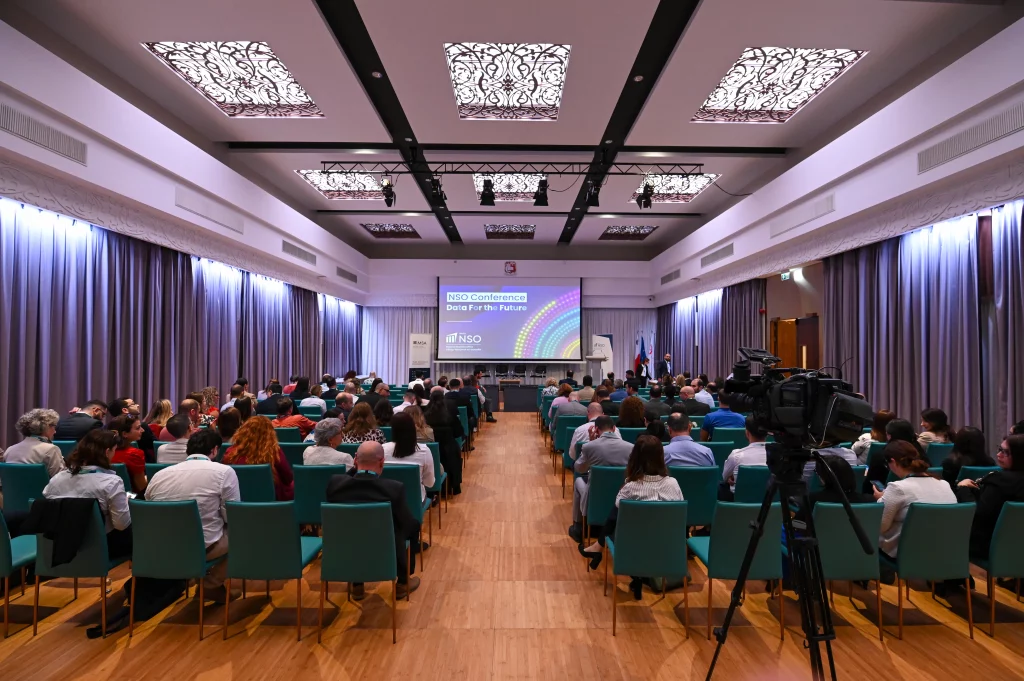
The NSO receives the Public Service “Good Governance Award” (2025)
Users’ Conference: Data for the Future (2025)
Over the past 25 years, the NSO has grown into a modern, innovative, and trusted institution. Anchored in its core values—independence, objectivity, relevance, quality, transparency, confidentiality, and collaboration—it continues to provide reliable statistics that inform and empower both decision-makers and the public. Building on a proud legacy, the NSO looks ahead with confidence, ready to shape the future of Malta’s national statistical system.