Registered Business Units: 2025
Effective from reference year 2025, Registered business units data will be classified according to the recently updated version of the EU statistical classification of economic activities, NACE Revision 2 Update 1 (NACE Rev. 2.1). Further information on these changes is provided in Methodological Note 3 of this news release.

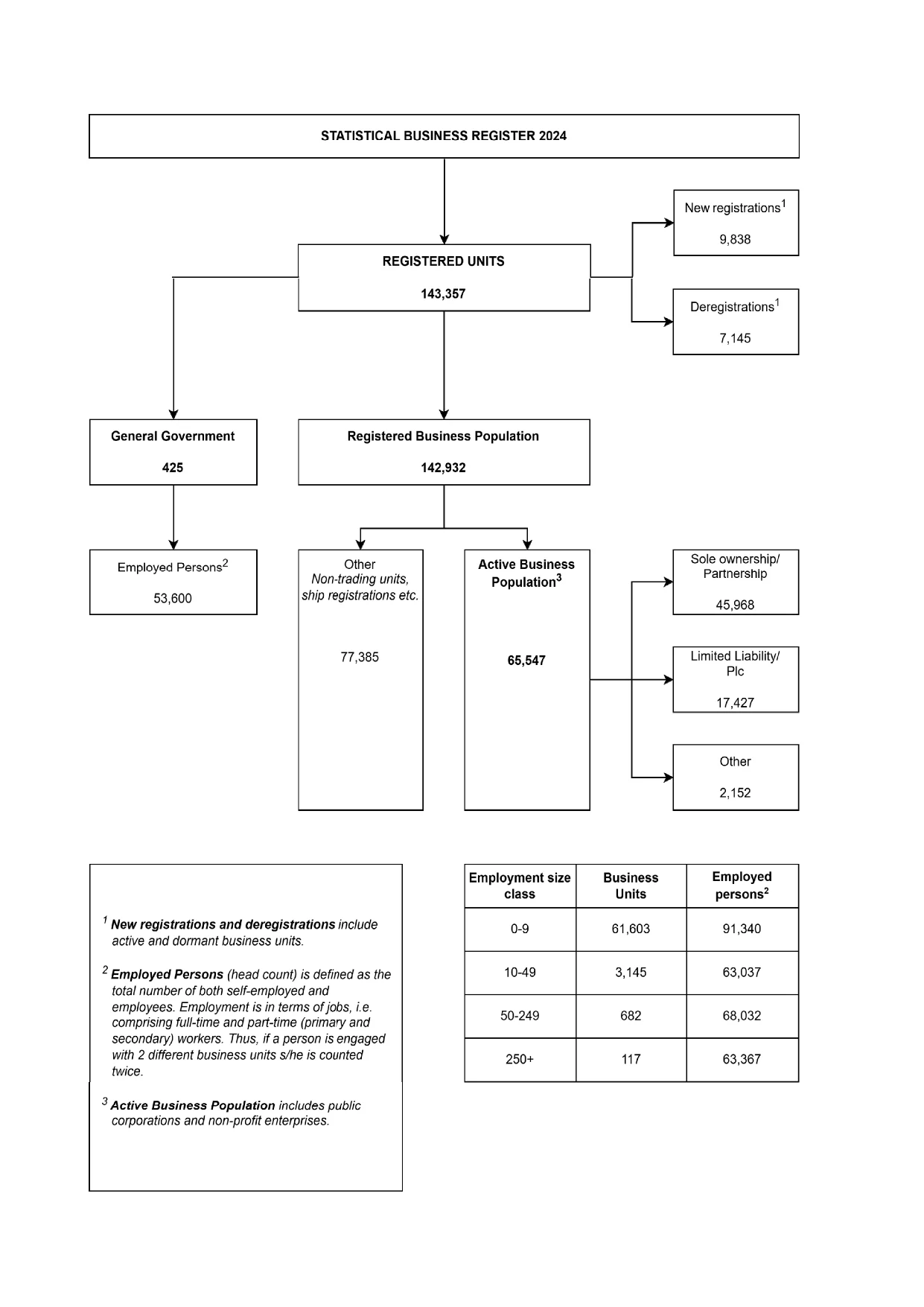
- In 2025, registered business units within the statistical business register amounted to 146,420.
- In 2025, businesses in Professional, scientific and technical activities (Section N), Financial and insurance activities (Section L), and Wholesale and retail trade (Section G) covered 36.5 per cent of total registered units.
- In 2025, 58.7 per cent of registered business units were sole owners (or partnerships) while 37.6 per cent were limited liability companies (or Plc).
- New registrations in 2025 amounted to 10,208 units.
Registered Business Units: 2025
Registered Business Units: 2025
Effective from reference year 2025, Registered business units data will be classified according to the recently updated version of the EU statistical classification of economic activities, NACE Revision 2 Update 1 (NACE Rev. 2.1). Further information on these changes is provided in Methodological Note 3 of this news release.

Registered units in Professional, scientific and technical activities (Section N) accounted for 14.2 per cent of the total registered units in 2025, Financial and insurance activities (Section L) accounted for 11.4 per cent; Wholesale and retail trade (Section G) accounted for 11.0 per cent; and Administrative and support service activities (Section O) accounted for 7.7 per cent (Table 1).
Registered units within Professional, scientific and technical activities (Section N) increased by 694 units, a 3.4 per cent rise; while Transportation and storage (Section H) increased by 330 units, also representing a 3.4 per cent increase when compared with 2024. Arts, sports and recreation (Section S) rose by 322 units, corresponding to an increase of 3.9 per cent when compared with 2024.
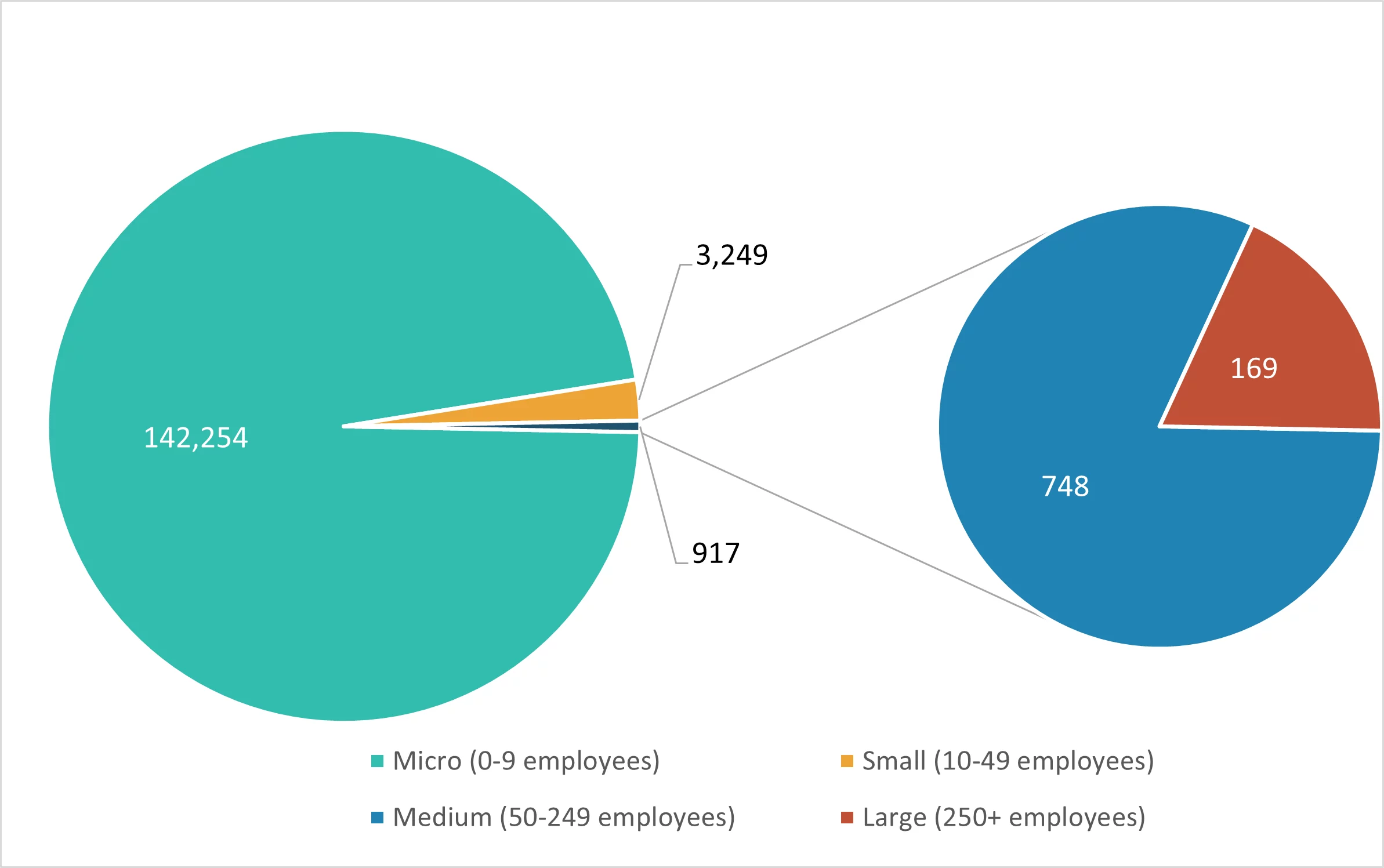
Most of the business units (97.2 per cent) employed between 0 to 9 persons (micro). The population of small (10 – 49) and medium (50 – 249) businesses accounted for 3,249 (2.2 per cent) and 748 (0.5 per cent) units respectively. The large businesses employing 250 and more amounted to 169 (0.1 per cent) (Chart 1, Table 1).
Chart 1. Registered units in 2025, by employment size
In 2025, 58.7 per cent of the registered units were sole owners or partnerships, 37.6 per cent were limited liability or public limited companies (Plc), while 3.7 per cent were governmental, non-profit or other types of legal organisations (Chart 2, Table 2).
New registrations in 2025 amounted to 10,208 units, while deregistrations stood at 8,131 units. (Chart 3, Table 3).
Tables
Tables
Effective from reference year 2025, Registered business units data will be classified according to the recently updated version of the EU statistical classification of economic activities, NACE Revision 2 Update 1 (NACE Rev. 2.1). Further information on these changes is provided in Methodological Note 3 of this news release.
Methodological Notes
1. The statistical business register is the source of the data in this news release. The statistical business register provides one of the most detailed local business profiles in Malta.
2. Business registrations are based on administrative data. Registrations and/or deregistrations do not precisely record commencement or cessation of an activity by a unit. Demographic events such as takeovers, mergers and split-offs are not catered for and may affect the data presented.
3. The data is classified by economic activity according to the NACE (Nomenclature Statistique des Activités Économiques dans la Communauté Européenne) classification of economic activities in the European Union. The data is presented in accordance with NACE Revision 2 Update 1 (NACE Rev. 2.1), reflecting the latest updates to the classification system. To support continuity and facilitate comparison with previous releases, data tables compiled according to NACE Rev. 2 are also provided. Dual coding of economic activity classifications, covering both NACE Rev. 2 and NACE Rev. 2.1 has been implemented in the statistical business register from 2021 onwards.
The main changes in the classification at NACE section level introduced by NACE Rev. 2.1, compared with NACE Rev. 2, include:
a. Section J of NACE Rev. 2 has been split into two sections: Section J, ‘Publishing, broadcasting, and content production and distribution activities’ and Section K ‘Telecommunication, computer programming, consulting, computing infrastructure and other information service activities’. As a result, all the subsequent sections in NACE Rev. 2.1 shifted up one letter.
b. Group 41.1 ‘Development of building projects’ has been removed from section F. Its sole class, 41.10, has been reclassified under class 68.12 within section M (formerly section L).
c. Division 45 ‘Wholesale and retail trade and repair of motor vehicles and motorcycles’ has been discontinued from section G. The wholesale and retail activities of motor vehicles and motorcycles have been allocated to division 46 and 47 respectively, while the activities of maintenance and repair of motor vehicles and motorcycles were moved to section T (formerly section S).
d. The classification of real estate rental activities has been refined: rentals of own or leased real estate for periods of less than one year are now classified under Division 55 (Section I), whereas rentals for one year or longer remain under Division 68 (Section M – formerly section L).
More information on the reclassification can be found in the relevant Press Information Notice and in the News article by Eurostat.
4. Other types of legal structures may include public corporations, cooperatives and joint ventures.
5. Micro enterprises include non-trading units.
6. Updates in the statistical business register are ongoing and all figures reported are subject to revision.
7. Registered business units include all units that were registered for at least one day during the reporting period. Units that ceased operating, as shown in Table 3 and Table 6, are still included among the registered business units in Tables 1, 2, 4 and 5 if they were registered for at least one day in the year in which their deregistration occurred.
8. More information relating to this news release may be accessed at:
Statistical Concepts
Classification NACE Rev. 2
Classification NACE Rev. 2.1
9. References to this news release are to be cited appropriately.
10. A detailed news release calendar is available online.
Definitions
The following are the definitions of the employment size class breakdowns shown in Table 1 and Table 4:
| Size class | Persons employed | |
|---|---|---|
| Micro | 0-9 | |
| Small | 10-49 | |
| Medium | 50-249 | |
| Large | 250+ |
The following are the definitions of the legal forms:
Sole ownership is defined as enterprises owned exclusively by one natural person.
Partnership is defined as an association of persons who conduct a business under a collective name.
Limited liability companies refer to enterprises comprising joint-stock companies and private limited companies.
Government units are legal entities established by political processes that have legislative, judicial or executive authority over institutional units within a given area. These include government ministries and departments.
Non-profit organisations are legal or social entities acting for the purpose of producing goods and services whose status does not permit them to be a source of income, profit or other financial gains for the units that establish, control or finance them.
Public corporations are all the government-controlled units that are often established by government as market producers principally engaged in the production of goods, non-financial and financial services, and as such they are classified in non-financial and financial sectors.
Cooperatives are bodies set down by law that observe a number of general principles; for example profits are often distributed in proportion to members’ dealings with the society.