
Domestic Violence: 2025

PDF Share
Subscribe for Statistical Updates
Man Being Physically Abusive Towards Family, Sexual abuse , Stop violence, Women

Salient Points

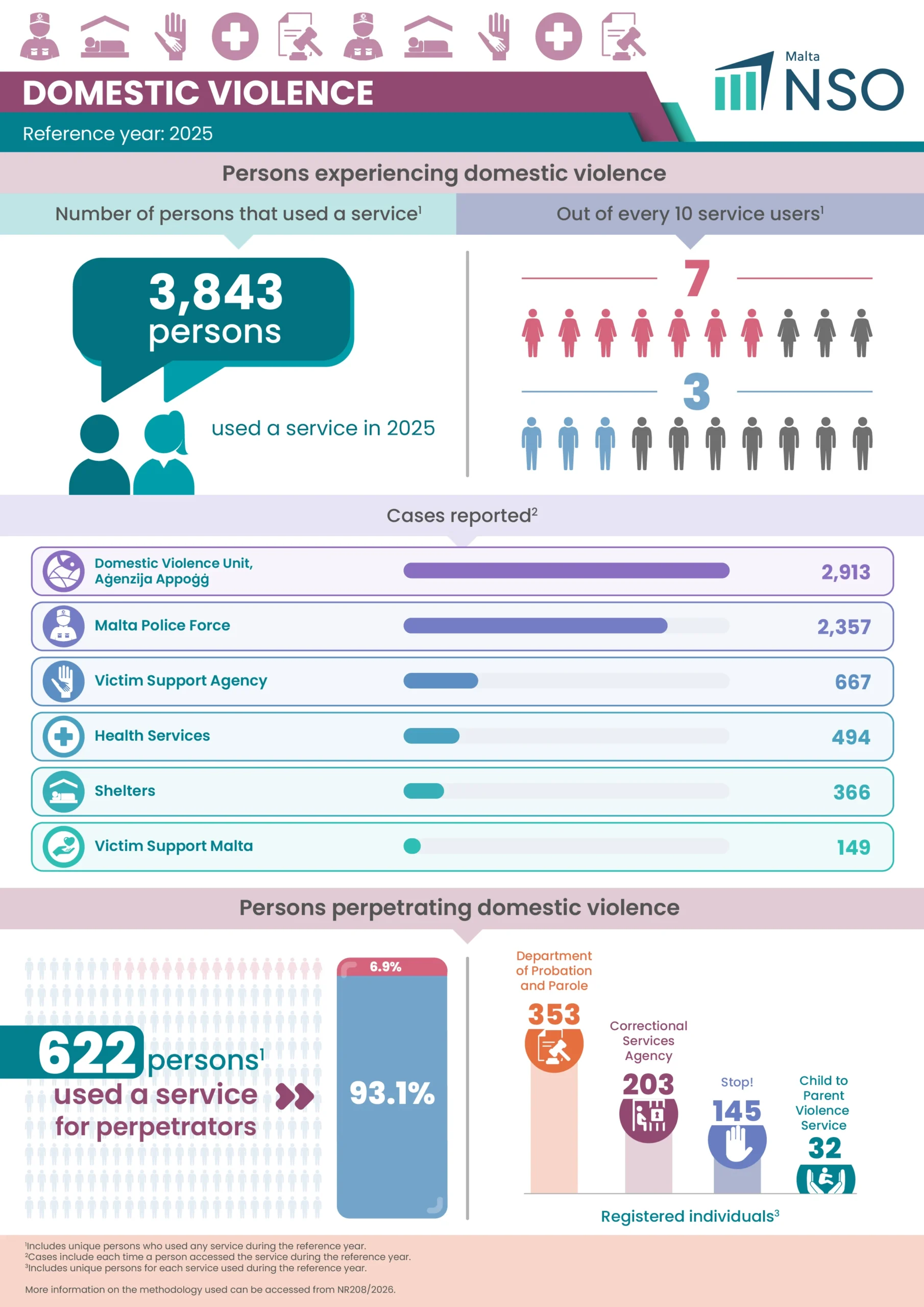
  • In 2025, 3,843 individuals reported experiencing domestic violence or made use of services available within this area.
  • Of the persons making use of services offered to those experiencing domestic violence, 74.0 per cent were females.
  • During 2025, 622 persons made use of services available for perpetrators, of whom 93.1 per cent were male.

Commentary

In 2025, 3,843 persons reported experiencing domestic violence or made use of services available within this area. Of these, 74.0 per cent were females.

Just under three quarters of service users (74.0 per cent) in 2025 were female, while 26.0 per cent were male. The majority of persons (55.4 per cent) used any service only once during the reference year, with 23.8 per cent using one or more services twice, and 20.8 per cent using one or more services three times or more. Among females, 45.9 per cent used any service more than once, compared with 40.9 per cent of males (Table 1 and Chart 1).

Domestic violence services by sex

Notes:
1.  Figures refer to the total number of individual persons making use of services during the reference period (refer to Table 1; methodological note 3 and 6).
2.  Services included: Dar Emmaus, Dar Merħba Bik, Dar Santa Bakhita, Domestic Violence Unit (Aġenzija Appoġġ), Emergency Health (A&E), Għabex, Il-Milja, Malta Police Force, Primary HealthCare,
Victim Support Agency, and Victim Support Malta.

Table 2 presents data on cases registered across the different service providers. Cases counted within and across services may involve the same person more than once. During 2025, a total of 6,946 cases were registered by the different entities providing a form of service to persons experiencing domestic violence. In 2025, as in previous years, the main services used by persons experiencing domestic violence were the Domestic Violence Unit (DVU) within Aġenzija Appoġġ (2,913 registered cases) and the Malta Police Force, which received 2,357 reports during the year under review (Table 2).

The Southern Harbour district recorded the highest utilisation of services offered by the Domestic Violence Unit, with 11.7 female service users per 1,000 female residents and 2.8 male service users per 1,000 male residents. It also registered the highest rate of domestic violence reports with the Malta Police Force, with 9.4 reports from females per 1,000 female residents and 3.3 reports from males per 1,000 male residents. In contrast, the Gozo and Comino district reported the lowest rates of service users at Aġenzija Appoġġ per 1,000 residents. The Gozo and Comino district, along with the Northern Harbour district, had the joint lowest rate of domestic violence reports registered with the Malta Police Force per 1,000 residents (Maps 1 and 2).

Map 1. Number of individual cases registered with the Domestic Violence Unit at Aġenzija Appoġġ by district of residence of service user (rate per 1,000 resident population)

Map 2. Number of individual cases registered with the Malta Police Force by district of incident (rate per 1,000 resident population)

Notes:
1. Individual cases are recorded by the service provider each time a person accesses the service during that reference year. Therefore, figures include persons making use of services more than once.
2. Data recorded by the Domestic Violence Unit at Aġenzija Appoġġ includes the district of residence of the service user.
3. Data recorded by the Police Department includes the district of incident reported.
4. Rates are based on mid-year population estimates which may be subject to revision.

Chart 2

¹ Health services include health centres and clinics operated by Primary HealthCare, as well as the emergency departments at Mater Dei Hospital and Gozo General Hospital.
² Shelters include Dar Emmaus, Dar Merħba Bik, Dar Santa Bakhita, Għabex, and Il-Milja. Refer to methodological note 1.
Note: Individual cases are recorded by the service provider each time a person accesses the service during that reference year. Therefore figures include persons making use of services more than once.

Table 3 breaks down cases registered with domestic violence service providers by the age group of the registered service user. In 2025, 28.5 per cent of the total cases registered across all services involved persons aged between 30 and 39 years, while 24.1 per cent involved persons aged 50 years and over (Table 3 and Chart 2).

The majority, 82.0 per cent, were cases involving Maltese nationals (Table 4). The services with the highest percentages of foreign service users were domestic violence shelters at 42.1 per cent, and Victim Support Malta at 24.2 per cent (Chart 3).

Highcharts Tooltip — Chart 3 (No Total)

¹ Health services include health centres and clinics operated by Primary HealthCare, as well as the emergency departments at Mater Dei Hospital and Gozo General Hospital.
² Shelters include Dar Emmaus, Dar Merħba Bik, Dar Santa Bakhita, Għabex, and Il-Milja. Refer to methodological note 1.
Note: Individual cases are recorded by the service provider each time a person accesses the service during that reference year. Therefore figures include persons making use of services more than once.

Table 5 indicates the types of violence reported in cases registered with domestic violence services, with users being able to report more than one type of violence, except for reports registered with the Malta Police Force. Nearly three quarters of cases (72.8 per cent) reported across the different service providers involved psychological violence, while 45.7 per cent involved physical violence. 10.6 per cent of all reported cases involved sexual, economic and/or another form of violence (Table 5).

This news release also covers services targeting perpetrators of domestic violence. Data for 2025 includes the ‘Stop!’ programme and the ‘Child to Parent Violence’ service, both of which are provided by Aġenzija Appoġġ, the Department of Probation and Parole, and the Correctional Services Agency. The majority of users of perpetrator services were male, with ‘Stop!’, the Department of Probation and Parole, and the Correctional Services Agency recording over 93 per cent of their service users as male. The ‘Child to Parent Violence’ service saw the largest percentage of female service users at just under a quarter (21.9 per cent). In terms of the unique number of persons using any service targeting perpetrators, 622 individuals used one or more services during 2025 (Table 6 and Chart 4).

Chart 4 — Gender by Service Provider (100% Stacked)

Note: Total figures represent the number of individual persons registered at the respective service and therefore persons accessing different services are counted more than once. 

Tables

Methodological Notes

1. The sources of data referenced in this news release are:
• Aġenzija Appoġġ: The national agency for children and families which promotes their well-being through psycho-social welfare services. Information about both parents and children who make use of the service is recorded. Furthermore, cases of minors receiving child protection interventions by the Child Protection Services offering protection to vulnerable children and adolescents under the age of eighteen years may be recorded as a Child Protection case and not included in this data.
 
• Child to Parent Violence Service: A service offered by Aġenzija Appoġġ, this programme is aimed at children who are abusive towards their parents or primary caregivers. The service aims to bring all members of the family towards the available support services, and provide support through social workers or other professionals to address the safety and protection of each family member. Data are included from 2022 onwards.
 
• Correctional Services Agency (CSA): The CSA works within the criminal justice system implementing the Courts’ decisions as regulated by the Prisons Act (Cap. 260 of the Laws of Malta). The CSA is responsible for the Corradino Correctional Facility, the Forensic Unit at Mount Carmel Hospital, and the Centre of Residential Restorative Service. Alongside implementing the Courts’ decisions, the CSA aims to provide programmes to help inmates address offending behaviour, and to prepare inmates for re-integration into the community as responsible citizens. Data provided in this news release refers to persons under the care of the CSA during the reference year.
 
• Dar Santa Bakhita: A second stage shelter providing accommodation and assistance to women and children who have experienced domestic or gender-based violence. Data on children accompanying their guardians and using this service are included from 2023.
 
• Dar Merħba Bik: An emergency shelter providing immediate short-term accommodation and support for women and children who have experienced domestic violence. Data on children accompanying their guardians and using this service are included from 2023.
 
• Dar Emmaus: A residential shelter for victims of domestic violence in Gozo. The shelter also caters to families and homeless persons who are in need of support. It aims to provide individualised support services, helping users deal with any applicable social issues. Data are included from 2022 onwards.
 
• Department of Probation and Parole (DPP): The DPP offers a service within the criminal justice system and works in collaboration with the Judiciary, law enforcement, various agencies and Government departments, amongst others. The DPP aims at enhancing community safety by reducing recidivism through the implementation of restorative justice measures and the use of community-based sanctions such as probation and parole.
 
• Emergency Health Services (A&E): Data on patient injuries is collected and provided by emergency departments across Malta and Gozo. This includes information from Mater Dei Hospital and Gozo General Hospital and exclude private hospitals/clinics and private healthcare practitioners.
 
• Għabex: An emergency shelter providing immediate short-term accommodation and support for women and children experiencing violence within the family, in intimate relationships or from human trafficking. Both adults and children who attend the shelter are recorded as separate service users.
 
• Il-Milja: Formally known as Dar Qalb ta’ Ġesu. Il-Milja is a second stage shelter which provides long-term accommodation and support for women and children in order to prepare them for independent living after experiencing domestic violence. Data on children accompanying their guardians and using this service is not available and only data on adults is provided. Data are included from 2017 onwards.
 
• Malta Police Force: The Malta Police Force statistics section collects and provides data on all reports of domestic violence that have been made with them and registered in the National Police System (NPS). Individuals, including children, involved in a domestic violence report are recorded as separate victims. Data is recorded by the Malta Police Force based on reports registered within the NPS which captures the Police Incident Reporting System (PIRS). This system collects information on all police reports filed at police districts and stations throughout Malta and Gozo. The system records cases based on the main crime category of the report, i.e. the crime that is associated with the gravest penalty as established by relative legislation.
 
• Primary HealthCare: Primary HealthCare provides public primary health care services in the community, primarily through 10 Health Centres and 54 Community Clinics, with all services being free of charge. Data on patient injuries are collected centrally in an anonymised form and exclude private clinics and private healthcare practitioners. Data are included from 2025 onwards.
 
• Stop!: This service, previously known as the Managing Abusive Behaviour Service, is offered by Aġenzija Appoġġ. This is a service set up to assist the abusive partner in intimate relationships to become aware of, understand and change their behaviour.
 
• Victim Support Agency: Established under Legal Notice 418 of 2020, the Victim Support Agency provides necessary support and assistance to victims. This includes providing emotional support and guidance, providing information about the victims’ cases, accompanying victims in Court, and providing information on the release of related offenders from prison. A multidisciplinary and multiagency approach is promoted to ensure continuity of service to the victim. Data are included from 2023 onwards.
 
• Victim Support Malta: A non-governmental organisation which provides support and assistance to victims of crime. Information provided in this regard covers those persons benefiting from services provided by Victim Support Malta for reasons of domestic violence. Currently this service is provided to persons experiencing domestic violence and aged 18 and over. Some of the data was not available from VSM for reference year 2020 as further noted in the respective tables.
 
2. Definitions of the types of violence:
 
• Domestic violence: All acts or omissions, including verbal, physical, sexual, psychological or economical violence causing physical and, or moral harm or suffering, including threats of such acts or omissions, coercion, or arbitrary deprivation of liberty, that occur within a family and, or in an intimate relationship, whether or not the perpetrator resides or has resided in the same residence with the victim, and shall also include children who are witnesses of violence within a family and, or an intimate relationship, as described in Cap. 581 of the Laws of Malta.
 
• Gender-based violence: All acts or omissions that are directed against a person because of their gender, that result in, or are likely to result in, physical, sexual, psychological or economic harm or suffering, including threats of such acts, coercion or arbitrary deprivation of liberty, whether occurring in public or in private life, as described in Cap. 581 of the Laws of Malta.
 
• Physical violence: Any act which causes physical harm as a result of unlawful physical force such as bodily harm or deprivation of liberty, as described in Articles 214-222 and 251 of Cap. 9 of the Laws of Malta.
 
• Psychological violence: Any act which causes psychological harm to an individual such as coercion or harassment, as described in Article 251 of Cap. 9 of the Laws of Malta.
 
• Sexual violence: Any sexual act performed on an individual without their consent such as rape or sexual assault, as described in Articles 198-209 of Cap. 9 of the Laws of Malta.
 
• Economic violence: Any act or behaviour which causes economic harm to an individual such as restricting access to finances, as described in Article 251 of Cap. 9 of the Laws of Malta.
 
• Other acts of violence: Any other act or behaviour, not elsewhere classified and registered with the different service providers in the area. Other forms of violence include stalking, neglect, deprivation of liberty, exploitation and human trafficking.
 
3. Measuring unit:
 
• Persons (Tables 1 and 6): Unique persons who made use of any services in the area during the reference period. Following a harmonisation exercise (refer to methodological note 5) all the cases registered with the Malta Police Force and different service providers are analysed and, in the case of persons making use of services more than once, such persons are counted only once. Figures across reference periods may include persons who have been included as victims or perpetrators during previous years.
 
• Cases (Tables 2 – 5): All individual cases registered at the respective service within the reference period. Persons who make use of the services may be counted more than once within or across services.
 
• Rate:
• Domestic Violence Unit (Map 1): Number of cases registered by victim’s location of residence per 1,000 mid-year resident population.
• Police reports (Map 2): Number of cases registered by location where incident occurred per 1,000 mid-year resident population.
 
4. Sex is a core demographic variable, serving as a key indicator to highlight gender disparities. As stated in the guidelines on standardised key social variables in official statistics, “sex” refers to the biological and physiological characteristics defining a person as male or female. Where such information is unavailable, it may be supplemented by the relevant administrative records or by the variable “self-declared sex” collected from social surveys. Administrative data related to civil processes typically reflects the registered sex with National Authorities, in accordance with the Gender Identity, Gender Expression, and Sex Characteristics Act (Cap. 540). This includes any updates to the registered sex. In the context of this news release, “sex” refers to the declared information provided by the respective service provider registering the service user. Regarding data provided by the Malta Police Force, “sex” refers to the information registered within the national administrative register.
 
5. Coverage: Data within this news release is produced in calendar years, i.e. from the 1 January to the 31 December.
 
6. Harmonisation: To compute the total number of persons experiencing domestic violence, the data provided from the different stakeholders is analysed and harmonised to identify unique persons who have been found to make use of one or more services in the area of domestic violence during the year under review.
 
7. Confidentiality: As with all the data collected and processed by the NSO, data is governed by the provisions of the Malta Statistics Authority Act (XXIV of 2000). This Act emphasises both the NSO’s right to collect and process private and personal information for statistical purposes, while binding the NSO to refrain from providing any identifiable information to third parties.
 
8.  Comparability over time: Comparisons over time should be interpreted with caution because the coverage of the data has changed:
Data from 2023 onwards include the Victim Support Agency (VSA) as a new service, and improved coverage of accompanying minors using shelter services.
• Data from 2023 onwards include the Victim Support Agency (VSA) as a new service, and improved coverage of accompanying minors using shelter services.
• Data from 2025 onwards also include Primary HealthCare as a new data source, covering public health centres and community clinics in addition to the emergency departments at Meter Dei Hospital and Gozo General Hospital.
• These changes improve the data coverage but create breaks in series in 2023 and 2025. Consequently, changes between affected years may reflect both actual changes in service use and changes in data coverage and should not be interprted as stricly like-for-like comparisons.
 
9. More information relating to this news release may be accessed at:
 
10. References to this news release are to be cited appropriately. For guidance on access and re-use of data please visit our dedicated webpage.
 
11. A detailed news release calendar is available online.
 
12. For further assistance send your request through our online request form.
Skip to content