Job Vacancy Survey: Q3/2025

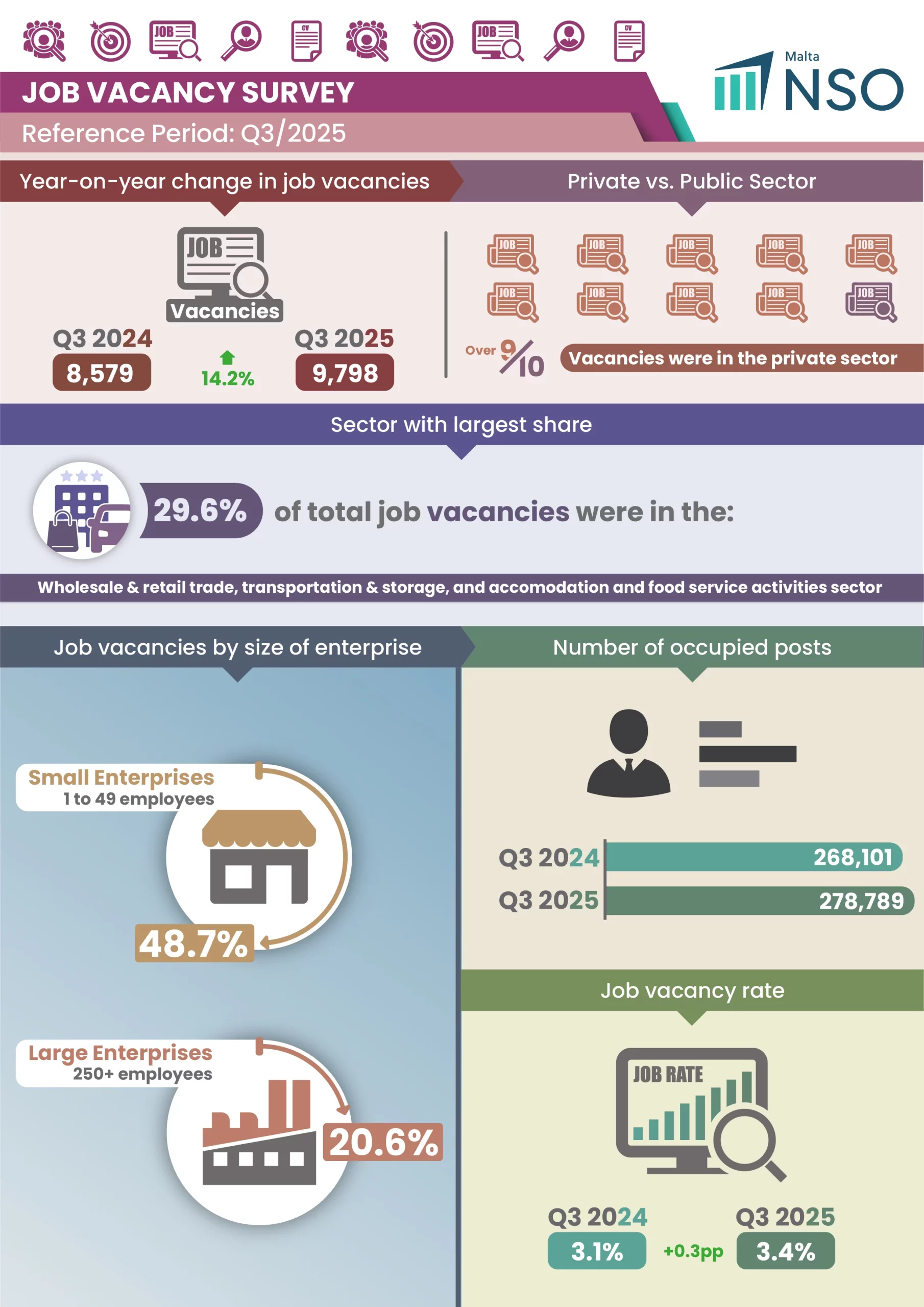
- In the third quarter of 2025, there were a total of 9,798 vacancies.
- The wholesale and retail trade, transportation and storage, accommodation and food services activities along with the professional, scientific, technical, administration and support service activities, generated more than half of all vacancies during the third quarter of 2025.
- Small enterprises having 1 to 49 employees accounted for 48.7 per cent of all vacancies, while the share of vacancies generated by companies with 250 employees or more amounted to 20.6 per cent.
- The private sector dominated the job vacancy market, representing 92.4 per cent of all vacant positions, with the public sector accounting for the remaining 7.6 per cent.
Job Vacancy Survey: Q3/2025
Job Vacancy Survey: Q3/2025

This news release presents the findings of the Job Vacancy Survey (JVS), a quarterly enterprise-based enquiry that provides insights into the demand for labour by gauging the number of vacancies and occupied posts.
Job Vacancies
In the third quarter of 2025, there were a total of 9,798 vacancies within enterprises employing one or more persons, registering an increase of 14.2 per cent over the same period in 2024 (Chart 1, Table 1).
Chart 1. Number of job vacancies and occupied posts
The wholesale and retail trade, transportation and storage, accommodation and food services activities along with the professional, scientific, technical, administration and support service activities, generated more than half of all vacancies during the third quarter of 2025. On the other hand, the real estate activities sector recorded the lowest number of job vacancies, standing at 1.1 per cent of the total number of calls for application in Q3 2025 (Chart 2, Table 1).
The highest year-on-year increase in the number of job vacancies was recorded within the wholesale and retail trade, transportation and storage, accommodation and food services activities, with an addition of 638 vacancies totalling to 2,904 vacancies. This was followed by the public administration, defence, education, human health and social work activities, which saw an increase of 529 vacancies. On the contrary, arts, entertainment and recreation; other services activities, experienced the largest drop when compared to the third quarter of 2024, with a reduction of 81 vacancies (Table 1).
Chart 2. Job vacancies by economic activity of enterprise
Data also shows an inverse relationship between enterprise size and the number of job vacancies. In this regard, small enterprises (1 to 49 employees) contributed to nearly half of the vacancies whereas companies with 250 employees or more generated 20.6 per cent of all vacancies of the third quarter of 2025 (Chart 3, Table 2).
Chart 3. Job vacancies by size class of enterprise
In the private sector, job vacancies increased by 866 between the third quarter of 2024 and the third quarter of 2025, totalling to 9,049, whereas within the public sector, the total for the same period stood at 749 (Table 3). As Chart 4 illustrates, the private sector continues to dominate the job vacancy market, representing 92.4 per cent of all vacancies, leaving the public sector with a 7.6 per cent share (Chart 4).
Chart 4. Job vacancies by economic sector
Q3 2024
Q3 2025
Occupied Posts
During the third quarter of 2025, the total number of occupied posts within enterprises employing one or more employees stood at 278,789. Over one half of these posts were recorded in public administration, defence, education, human health and social work activities and in the wholesale and retail trade, transportation and storage, accommodation and food service activities. Over a period of one year, the public administration, defence, education, human health and social work activities registered the largest growth of 7.3 per cent, followed by the real estate activities, registering a growth of 6.7 per cent . During the third quarter of 2025, 40.0 per cent of occupied posts were estimated to be in enterprises employing 250 employees or more. Units with 50 to 249 employees made up more than one fourth of all occupied posts (Chart 1, Table 4 and Table 5).
Occupied posts within the private sector stood at 219,307, garnering 78.7 per cent of the total amount of jobs. The public sector totalled 59,482, making up the remaining 21.3 per cent (Table 6).
Job Vacancy Rate
In the third quarter of 2025, 3.4 per cent of jobs in Malta were vacant, increasing by 0.2 percentage points when compared to the preceding quarter and 0.3 percentage points compared to the third quarter of 2024 (Chart 5, Table 7). The job vacancy rate was highest within the information and communication activities (5.1 per cent) whilst the public administration, defence, education, human health and social work activities registered the lowest rate of job vacancies (1.8 per cent) (Table 7).
Small enterprises, with 1 to 49 employees, showed a higher job vacancy rate of 4.8 per cent, suggesting a greater demand for labour in this segment. Large enterprises, comprising 250 or more employees, exhibited a lower rate of job vacancies at 1.8 per cent (Table 8).
The private sector registered a job vacancy rate of 4.0 per cent in the third quarter of 2025 whereas 1.2 per cent of total jobs in the public sector were vacant during the same period (Table 9).
Chart 5. Job vacancy rate
in relation to unemployment rate
Tables
Tables
Methodological Notes
1. The Job Vacancy Survey (JVS) is a quarterly enterprise survey carried out with over 3,200 entities employing one or more employees. Administrative sources are used to compile information relating to the public sector.
2. The objective of this survey, as laid down in the regulation (EC) No. 453/2008, is to provide information on the demand for labour at a reference date across units employing one or more employees and engaged in NACE sections B-S. The economic activity is classified according to NACE Rev. 2 (Nomenclature générale des Activités économiques dans les Communautés Européennes).
3. Definitions:
● A job vacancy is defined as a paid post that is newly created, unoccupied, or about to become vacant, for which the employer is taking active steps and is prepared to take further steps to find a suitable candidate from outside the enterprise concerned, and the employer intends to fill either immediately or within a specific period of time.
● Active steps to find a suitable candidate include:
notifying the job vacancy to the public employment services;
contacting a private employment agency;
advertising the vacancy in the media, for example, internet, newspapers and magazines;
advertising the vacancy on a public notice board;
approaching, interviewing or selecting possible candidates/potential recruits directly;
approaching employees and/or personal contacts;
using internships.
● The term ‘within a specific period of time‘ refers to the maximum time the vacancy is open and intended to be filled. When the period is unlimited, all vacancies for which active steps are ongoing after the reference date shall be reported.
● An occupied post means a paid post within the organisation to which an employee has been assigned. This value excludes all board members, self-employed owners, directors, partners and managers who are solely paid by way of profits, persons on unpaid leave, posts unoccupied due to long-term absences (e.g., parental leave or long-term sickness) together with employees of temporary employment agencies, outside contractors or consultants, and voluntary workers.
● The Job Vacancy Rate (JVR) is calculated using this formula:
● The Job Vacancy Survey takes a snapshot of the number of job vacancies and occupied posts on a specific day, known as the reference date. For 2017, the reference date was the 30th day of the end of quarter month (i.e., March, June, September, and December). As from 2018, the reference date was the 15th day of the end of quarter month (i.e., March, June, September, and December). Starting from the first quarter of 2024, the reference date has been changed to the 28th day of the middle quarter month (i.e., February, May, August, and November).
● The unemployment rate refers to the number of unemployed persons (15-74 years) as a percentage of the total labour force (15-74 years). Unemployment rates were obtained from the Labour Force Survey (LFS).
4. Data in this news release is provisional and therefore subject to revisions. These revisions generally occur annually to align the estimates with the latest population figures. Additionally, quarterly revisions may be necessary to ensure the consistency of the data series. Also, totals may not add up due to rounding.
5. Figures that have a relative margin of error of 30 percent or more should be interpreted with caution. Such data may not be statistically representative due to the high potential for error.
6. More information relating to this news release may be accessed at:
Sources and Methods
Statistical Concepts
Metadata
NACE Rev. 2 Classification
7. References to this news release are to be cited appropriately. For guidance on access and re-use of data please visit our dedicated webpage.
8. Further information on the regulation (EC) No. 453/2008 can be accessed here.
9. A detailed news release calendar is available online.
10. For further assistance send your request through our online request form.